
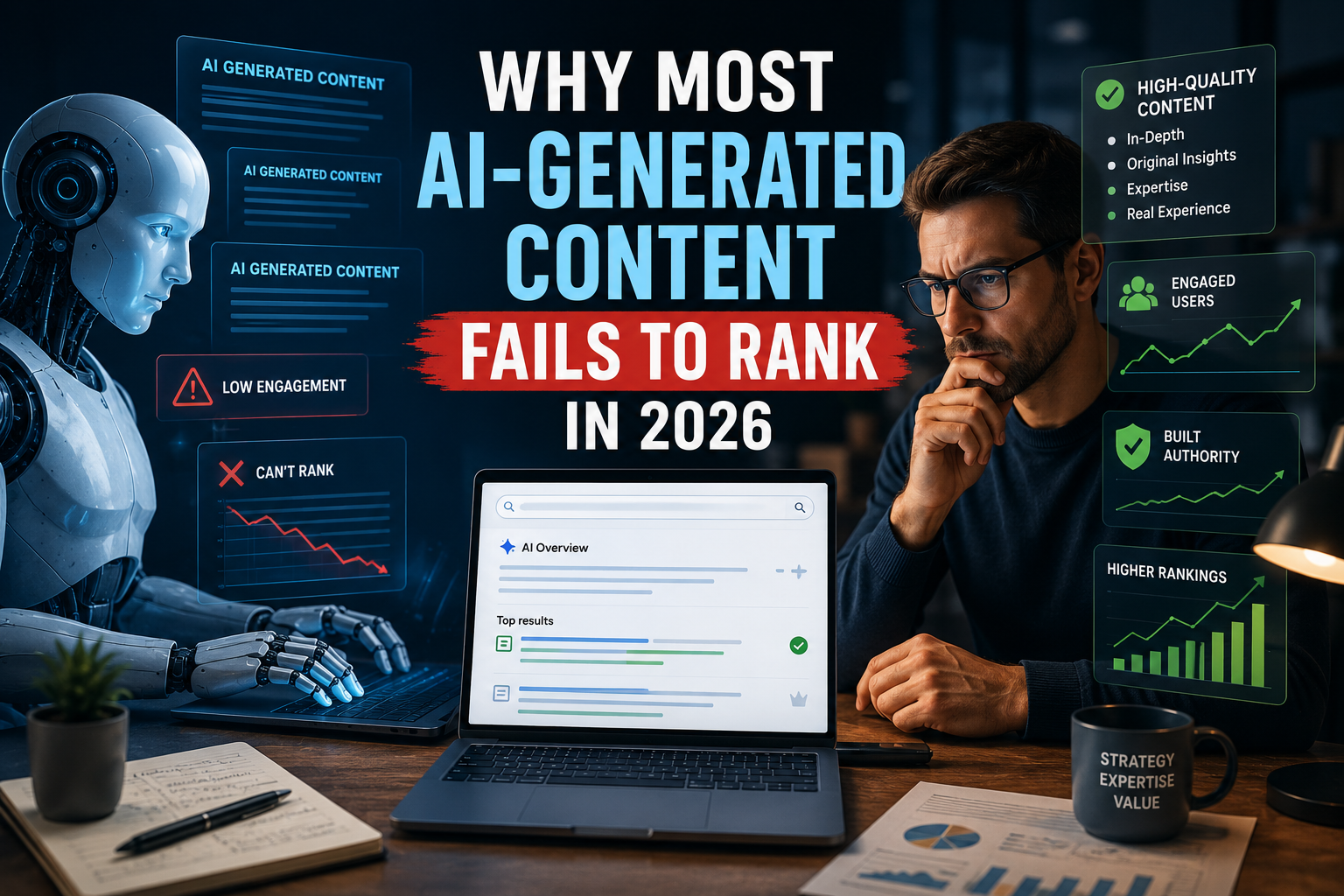

In 2026, AI writing tools are everywhere. Businesses use them to generate blogs, landing pages, product descriptions, and social media content at unprecedented speed. What once took days can now be produced in minutes.
On the surface, this seems like a major advantage. Faster publishing means more content, more indexed pages, and theoretically more opportunities to rank.
Yet many businesses are discovering an uncomfortable reality: despite publishing large amounts of AI-generated content, their rankings remain stagnant or decline altogether.
The reason is simple. Search engines have become significantly better at evaluating content quality, depth, and authority. AI can accelerate production, but volume alone no longer guarantees visibility.
Search Engines Are Smarter Than Before
A few years ago, SEO strategies often focused heavily on keywords and publishing frequency. That approach no longer works consistently.
Modern search engines evaluate:
- Search intent alignment
- Originality and depth
- User engagement signals
- Content structure and clarity
- Topical authority
- Trust and expertise indicators
AI-generated content often performs adequately at the surface level but struggles in areas that require genuine insight and contextual understanding.
Search algorithms in 2026 are heavily influenced by AI themselves. They are designed to detect value, not just words.
The Biggest Problem: Generic Content
Most AI-generated articles fail because they sound similar to everything else online.
AI models are trained on existing internet content. As a result, they often reproduce:
- Common phrasing
- Repetitive structures
- Surface-level explanations
- Predictable conclusions
When hundreds of websites publish near-identical articles about topics like SEO services, website development services, or digital marketing trends, none of them stand out.
Search engines prioritize differentiation. If your content offers no unique value, there is little reason for algorithms to rank it above competitors.
AI Lacks Real Experience
One of the strongest ranking signals in 2026 is demonstrated expertise.
Search engines increasingly favor content that includes:
- Real-world examples
- Strategic insights
- Case studies
- Industry-specific context
- Practical experience
AI can explain what technical SEO is, but it cannot genuinely describe how a specific SEO issue affected a real business project unless a human provides that context.
This is where purely AI-generated content often feels hollow. It explains concepts without adding meaningful perspective.
Readers notice this too. Content that lacks authenticity usually results in lower engagement, shorter time on page, and weaker trust signals.
User Engagement Matters More Than Ever
Search engines now rely heavily on behavioral signals to evaluate quality.
If users:
- Leave quickly
- Stop scrolling early
- Avoid interacting with the page
Search engines interpret that as dissatisfaction.
AI-written content frequently struggles with engagement because it tends to feel:
- Robotic
- Over-optimized
- Emotionally flat
- Repetitive
Human readers respond better to content that feels conversational, insightful, and experience-driven.
Ranking today is not just about getting indexed. It is about keeping users engaged once they arrive.
Thin Content No Longer Survives
Many businesses use AI to mass-produce short blog posts targeting slight keyword variations. This strategy rarely works in 2026.
Search engines now favor:
- Comprehensive explanations
- Clear structure
- Contextual depth
- Topic relevance
- Strong internal linking
A 500-word AI-generated article filled with generic advice struggles to compete against a well-structured, expert-driven resource.
Modern SEO rewards topical authority rather than isolated keyword targeting.
AI Content Often Misses Search Intent
Understanding user intent is one of the hardest parts of SEO.
A keyword may appear informational on the surface but actually contain:
- Commercial intent
- Local intent
- Comparison intent
- Transactional intent
AI tools frequently generate content based on literal interpretation rather than strategic search behavior.
For example, a user searching for “best SEO services for small businesses” may want:
- Pricing insights
- Trust indicators
- Case studies
- Service comparisons
AI-generated content often responds too broadly, missing the deeper intent behind the search.
That disconnect affects rankings.
Authority Has Become Critical
In 2026, ranking is increasingly influenced by domain authority and topical consistency.
Businesses that consistently publish high-quality content around focused subjects gradually build trust with search engines.
AI-generated content often fails because it is created without a broader strategy. Businesses publish disconnected articles simply to increase volume.
True authority requires:
- Structured content clusters
- Internal linking strategy
- Consistent expertise signals
- Technical optimization
- Strong service pages
SEO today is not about producing endless content. It is about building a credible digital presence.
AI Is Still Valuable — When Used Correctly
Despite its limitations, AI is not the problem.
In fact, AI can significantly improve content workflows when used strategically.
AI works well for:
- Research assistance
- Content outlines
- Topic ideation
- Meta descriptions
- Structural organization
- Draft acceleration
The problem occurs when businesses publish raw AI output without human refinement.
The best-performing content strategies in 2026 combine:
- AI efficiency
- Human expertise
- Editorial oversight
- Strategic SEO planning
This hybrid approach creates content that is scalable while still maintaining originality and authority.
What Businesses Should Do Instead
To create content that ranks in 2026, businesses should focus on:
1. Adding Real Insights
Include practical experience, examples, and strategic commentary.
2. Prioritizing User Experience
Write clearly, structure content properly, and improve readability.
3. Building Topical Authority
Publish related content consistently around core services.
4. Improving Technical SEO
Fast-loading, well-structured websites still matter significantly.
5. Using AI as a Tool — Not a Replacement
AI should support content teams, not fully replace expertise.
The Future of Content SEO
The future of SEO is not anti-AI. It is anti-generic.
Search engines are evolving toward rewarding:
- Expertise
- Authenticity
- Clarity
- Engagement
- Authority
Businesses relying solely on automation risk blending into a massive pool of repetitive content.
Those that combine intelligent tools with human strategy will continue to stand out.
Final Thoughts

No Comments