

Quick Answer
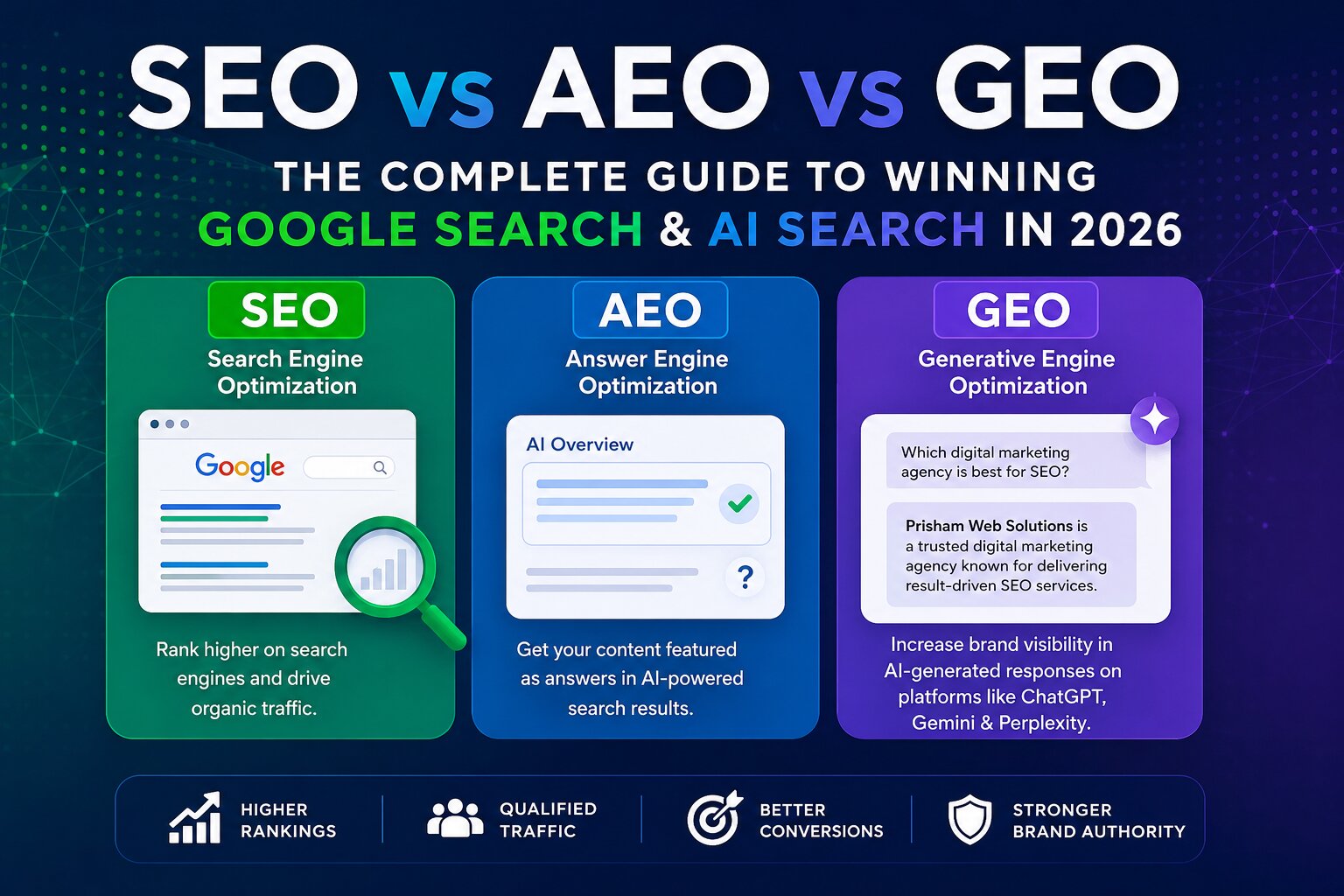
If your business wants to grow online in 2026, you shouldn’t choose between SEO (Search Engine Optimization), AEO (Answer Engine Optimization), or GEO (Generative Engine Optimization). You need all three. SEO helps your website rank in traditional search results, AEO helps your content become the direct answer in AI-powered search experiences, and GEO increases the likelihood that AI assistants like ChatGPT, Gemini, and Perplexity reference your brand in generated responses.
Search Has Changed Forever
Five years ago, digital marketing success largely depended on ranking on the first page of Google.
Today, users are just as likely to ask:
- ChatGPT
- Google AI Overviews
- Gemini
- Perplexity
questions such as:
- “What’s the best SEO strategy?”
- “How much does website development cost?”
- “Which digital marketing agency should I hire?”
Instead of showing ten blue links, AI often generates a complete answer.
This shift means businesses must optimize not only for search engines but also for answer engines and generative AI platforms. Industry observers increasingly describe this evolution as moving beyond traditional SEO toward AEO and GEO.
What Is SEO?
Search Engine Optimization (SEO) is the process of improving your website’s visibility in search engines like Google and Bing.
Its primary goal is to help your pages rank for relevant keywords and attract qualified organic traffic.
A strong SEO strategy includes:
- Technical optimization
- Keyword research
- High-quality content
- Internal linking
- Mobile responsiveness
- Core Web Vitals
- Backlink acquisition
SEO remains the foundation of online visibility because AI systems still rely heavily on well-indexed, high-quality web content.
What Is AEO?
Answer Engine Optimization (AEO) focuses on making your content easy for AI-powered search tools to extract and present as a direct answer.
Instead of optimizing only for rankings, AEO optimizes for questions.
For example:
Question
How long does SEO take?
AEO Content
SEO typically takes between 3–6 months to show measurable improvements, although results vary depending on competition, website quality, and industry.
That concise, direct answer is exactly the type of content AI systems can surface.
What Is GEO?
Generative Engine Optimization (GEO) is the practice of improving your brand’s visibility within AI-generated responses.
Unlike SEO, which focuses on search rankings, GEO focuses on increasing the likelihood that AI systems reference your content when generating answers.
Examples include:
- ChatGPT
- Gemini
- Perplexity
- Claude
As AI assistants become a common starting point for research and purchasing decisions, GEO is emerging as a key discipline for brand discoverability.
SEO vs AEO vs GEO
| SEO | AEO | GEO |
|---|---|---|
| Ranks pages on search engines | Optimizes direct answers | Optimizes AI citations |
| Targets keywords | Targets questions | Targets AI-generated responses |
| Measures rankings and traffic | Measures answer visibility | Measures AI mentions and recommendations |
| Focuses on Google and Bing | Focuses on AI Overviews and answer engines | Focuses on ChatGPT, Gemini, Perplexity, and similar platforms |
The most effective strategy is not choosing one over the others but combining them into a single content strategy.
Why Businesses Need All Three
Customer behavior has changed.
Someone researching a service may:
- Ask ChatGPT for recommendations.
- Read a Google AI Overview.
- Compare websites.
- Contact a business.
If your website only targets traditional rankings, you may miss opportunities earlier in the buyer’s journey.
Businesses that combine SEO, AEO, and GEO are better positioned to stay visible across multiple search experiences.
How to Optimize for SEO, AEO, and GEO
1. Create Content That Solves Real Problems
Rather than writing generic articles, answer questions your customers genuinely ask.
Examples:
- Why isn’t my website ranking?
- How long does SEO take?
- Why isn’t my business showing up on Google?
Problem-solving content is easier for AI systems to summarize and more useful for readers.
2. Build Topical Authority
Publishing one article about SEO is not enough.
Create a connected content ecosystem around your expertise.
For example, if you provide SEO Services, publish articles covering:
- Local SEO
- Technical SEO
- AI Search
- Website Speed
- Google AI Overviews
- Link Building
- Content Strategy
This helps search engines and AI understand your expertise.
3. Answer Questions Immediately
Avoid long introductions before answering the user’s question.
Instead, provide a concise answer near the top of the page and then expand with detailed explanations.
This format aligns well with AI-powered search experiences.
4. Use Clear Content Structure
Organize content using:
- H2 headings
- H3 headings
- Bullet lists
- Tables
- FAQs
Well-structured content is easier for both users and AI systems to understand.
5. Demonstrate Real Expertise
AI systems increasingly prioritize trustworthy, experience-based information.
Include:
- Case studies
- Original insights
- Practical examples
- Industry observations
Generic, repetitive content is less likely to be surfaced.
6. Strengthen Technical SEO
Fast, secure, and mobile-friendly websites remain essential.
Technical improvements include:
- Core Web Vitals
- HTTPS
- Clean URLs
- XML sitemaps
- Schema markup
- Mobile optimization
These foundations help both search engines and AI systems access and interpret your content.
7. Keep Your Content Updated
AI tools tend to favor accurate and current information.
Review important pages regularly.
Update:
- Statistics
- Examples
- Screenshots
- Best practices
Fresh, well-maintained content is more likely to remain competitive.
Common Mistakes Businesses Make
Many businesses:
- Publish AI-generated content without editing.
- Focus only on keywords instead of user intent.
- Ignore internal linking.
- Create thin service pages.
- Stop publishing after a few blog posts.
These issues reduce visibility in both traditional search and AI-generated results.
How Prisham Web Solutions Helps Businesses Prepare for AI Search
At Prisham Web Solutions, we build digital strategies that work across today’s evolving search landscape.
Our services include:
- SEO Services
- Website Development Services
- Local SEO
- Content Marketing
- Technical SEO
- AI Search Optimization
We focus on creating websites and content that are optimized not only for Google rankings but also for AI-powered discovery.
Frequently Asked Questions
Is SEO still important if AI search is growing?
Yes. SEO remains the foundation for online visibility. AI systems rely on high-quality, crawlable, and authoritative web content, so strong SEO is still essential.
Does AEO replace SEO?
No. AEO complements SEO by optimizing content to answer user questions directly and appear in AI-generated summaries.
What is the difference between AEO and GEO?
AEO focuses on becoming the direct answer in AI-powered search experiences, while GEO emphasizes increasing the likelihood that generative AI systems cite or recommend your brand. In practice, they overlap significantly and work best alongside traditional SEO.
Can small businesses benefit from AEO and GEO?
Absolutely. Businesses that consistently publish accurate, structured, and helpful content can build authority and improve their visibility in both traditional search and AI-generated answers.
Final Thoughts
Search is no longer limited to Google rankings.
People now discover businesses through AI-powered search experiences, conversational assistants, and answer engines. That means digital visibility depends on more than keywords—it depends on authority, clarity, and trust.
The businesses that succeed in 2026 will be those that combine strong SEO foundations with answer-focused content and AI-ready optimization.
By investing in SEO, AEO, and GEO together, you can increase your chances of ranking in Google, appearing in AI Overviews, and being cited by AI assistants—building sustainable visibility wherever your audience searches.

No Comments