
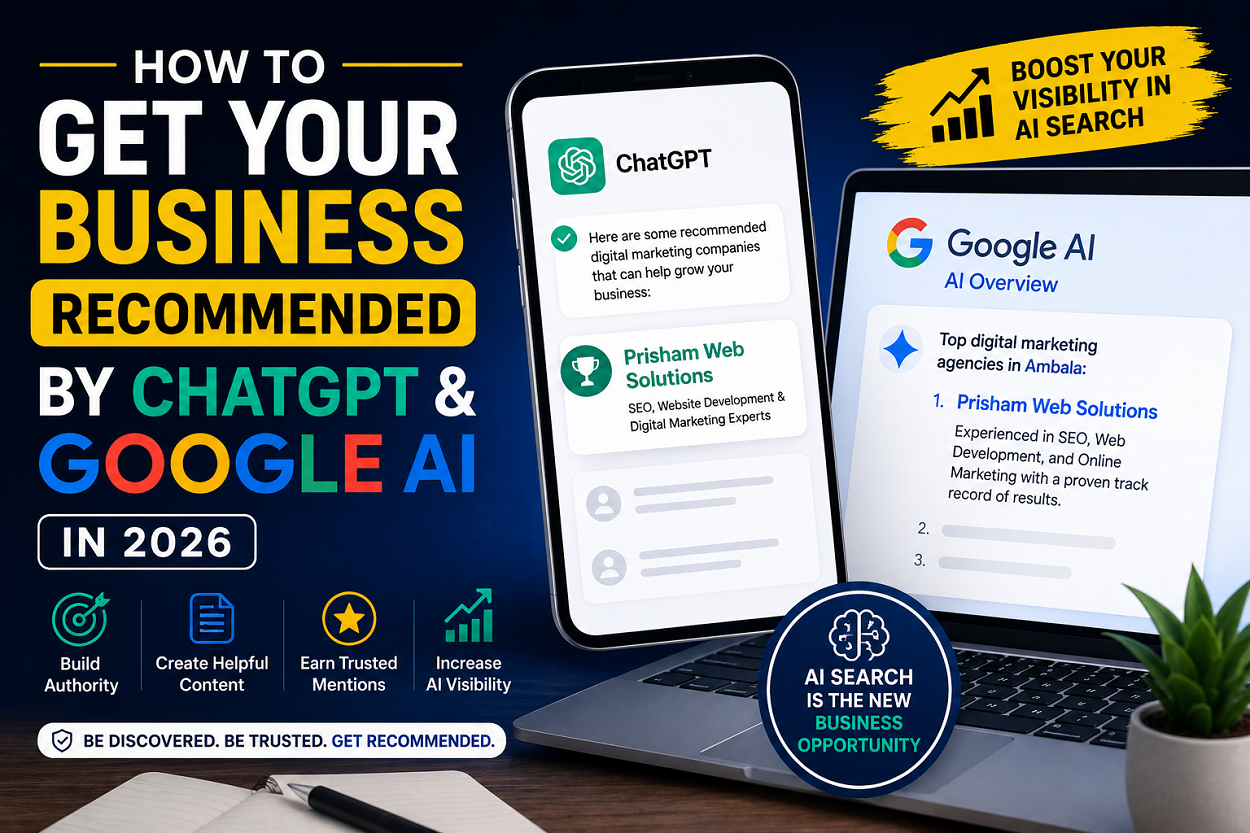

Quick Answer
To increase the chances of your business being recommended by ChatGPT, Google AI and other AI-powered search experiences, make your business easy to identify, verify and understand online.
That means maintaining a technically accessible website, publishing genuinely useful content, clearly describing your services and locations, building authority around your area of expertise, earning credible mentions across the web and keeping your business information consistent.
There is no special piece of code or guaranteed “ChatGPT ranking trick.” AI visibility is increasingly connected to the same qualities that make a business trustworthy to customers: relevance, authority, clarity, reputation and evidence.
Customers Are Starting to Ask AI Who They Should Hire
For years, businesses competed for searches such as:
“SEO company near me”
“best web development company”
“digital marketing agency in my city”
Those searches still matter.
But customer behaviour is expanding.
Someone can now ask an AI assistant:
“Recommend a digital marketing agency that specializes in SEO and website development for small businesses.”
Or:
“Which company can help my local business rank on Google and AI search?”
Instead of receiving a page containing ten blue links, the user may receive a summarized response containing a handful of companies, sources or recommendations.
That creates one of the biggest questions for businesses in 2026:
How do I get my company into those recommendations?
The answer starts with understanding that AI visibility is not simply another keyword-ranking exercise.
How Do AI Systems Know Your Business Exists?
Before an AI system can confidently discuss your company, there needs to be enough reliable information available to understand:
- Who you are
- What you do
- Where you operate
- What services you provide
- What topics you specialize in
- Whether other sources recognize your business
- Whether information about your company is consistent
Think about your online presence as a collection of evidence.
Your website provides some of that evidence.
But so can:
- Business profiles
- Industry directories
- News coverage
- Reviews
- Professional profiles
- Relevant backlinks
- Social profiles
- Third-party mentions
The clearer and more consistent these signals become, the easier it is for search systems to understand your business as an entity.
Can You Actually “Rank” in ChatGPT?
Not in exactly the same way you rank in traditional Google Search.
Google Search historically provides ranked results for a particular query.
Conversational AI responses are more dynamic. The answer can depend on the wording of the question, available information, the system being used and other contextual factors.
So businesses shouldn’t think:
“I want position #1 on ChatGPT.”
A better objective is:
“I want my company to become a credible candidate when AI systems answer questions relevant to my services.”
That changes the optimization strategy considerably.
1. Clearly Explain What Your Business Does
Start with the obvious.
Visit your homepage and ask:
Could someone understand exactly what we do within 10 seconds?
Many websites use vague statements such as:
Transforming ideas into digital experiences.
It sounds attractive but provides very little concrete information.
Compare it with:
Prisham Web Solutions provides SEO, website development and digital marketing services for businesses looking to increase search visibility, leads and online growth.
The second version gives machines and humans substantially more context.
Make your:
- Services
- Industries
- Locations
- Expertise
- Company information
clear throughout the website.
Clarity beats cleverness when users are trying to understand your business.
2. Create Dedicated Pages for Important Services
Don’t expect one homepage to establish expertise across everything your company provides.
If SEO is an important service, create a comprehensive SEO Services page.
If you provide local SEO, create a Local SEO Services page.
Do the same for strategically important offerings such as:
- Website Development
- Google Ads
- Social Media Marketing
- Content Marketing
Dedicated service pages help search engines understand the relationship between your business and specific services.
They also provide destinations for visitors who discover you through search.
3. Build Topical Authority Around Your Services
A service page tells search systems:
We offer SEO.
A complete content ecosystem can demonstrate:
We understand SEO.
That’s a much stronger signal.
For example, an SEO company could publish useful resources about:
- How long SEO takes
- Why websites lose rankings
- Local SEO
- Technical SEO
- Google AI Overviews
- AI search optimization
- Topical authority
- Website speed
- Search intent
- Internal linking
- Content quality
These articles shouldn’t exist merely to increase your page count.
Each should answer a genuine question potential customers ask.
Over time, this creates a connected body of expertise around your primary services.
4. Answer Questions AI Users Actually Ask
Traditional keyword research often focuses on short phrases.
AI conversations can be much more detailed.
Instead of:
SEO services
someone might ask:
“What should a small business look for when choosing an SEO company?”
Or:
“Why is my competitor ranking above me even though I have more Google reviews?”
This creates excellent content opportunities.
Talk to:
- Customers
- Sales teams
- Support teams
- Account managers
Identify the questions people repeatedly ask.
Then turn the best questions into comprehensive resources.
Real customer questions can be more valuable than another list of generic keywords.
5. Put Clear Answers Near the Top
If an article asks:
How long does SEO take?
Don’t spend 500 words explaining the history of SEO before answering it.
Provide the answer.
For example:
SEO commonly requires several months before meaningful organic improvements become visible, although the actual timeline depends on competition, website condition, authority, content and the market being targeted.
Then explain those factors.
This creates content that is:
- Easier to scan
- Easier to understand
- More useful on mobile
- Better suited to question-based search
It also makes individual passages more self-contained and understandable when discovered outside the context of the entire article.
6. Publish Information Competitors Cannot Easily Copy
This is where businesses have a major opportunity.
AI can generate another generic article explaining “10 Benefits of SEO” within seconds.
So can your competitors.
What can’t they easily reproduce?
Your experience.
Publish:
- Case studies
- Original research
- Internal data
- Client outcomes
- Experiments
- Lessons learned
- Expert observations
- Industry-specific insights
Instead of saying:
Website speed can improve conversions.
You could publish:
What Happened After We Improved the Page Speed of 20 Business Websites
That creates information worth discovering and potentially referencing.
7. Show Evidence of Experience
Claims are easy to make.
Evidence is harder.
If your website says:
“We deliver exceptional SEO results.”
a visitor has little reason to believe it.
Support important claims with appropriate evidence such as:
- Case studies
- Portfolio examples
- Client testimonials
- Project results
- Screenshots
- Methodology
- Team expertise
Don’t invent statistics merely to make content appear authoritative.
A smaller amount of genuine evidence is far more valuable than impressive-looking numbers that cannot be verified.
8. Strengthen Your Brand Beyond Your Own Website
Your website shouldn’t be the only place confirming what your business does.
Relevant third-party mentions can help strengthen overall brand credibility.
Depending on your business, these might include:
- Industry directories
- Local business directories
- Professional organizations
- Relevant publications
- Partner websites
- Podcasts
- Interviews
- Community organizations
- Reputable review platforms
The objective isn’t to create hundreds of spam directory profiles.
Focus on places that real customers or industry professionals would consider credible.
9. Keep Your Business Information Consistent
Imagine one website describes your company as being in Chandigarh.
Another says Mohali.
Your social profile lists a different phone number.
An old directory uses a previous company description.
Inconsistency creates confusion.
Review important information across your online presence:
- Business name
- Website
- Phone number
- Address, where relevant
- Service areas
- Business description
- Primary services
Consistency is particularly important for businesses targeting local customers.
10. Optimize Your Google Business Profile
For eligible local businesses, your Google Business Profile remains an important part of your search presence.
Keep important information accurate, including:
- Business category
- Hours
- Services
- Website
- Contact information
- Photos
- Business description
Reviews also matter to customers evaluating whether they should contact you.
Don’t treat your business profile as something you create once and forget.
Keep it accurate and useful.
11. Build Strong Local Landing Pages
Businesses serving multiple markets can benefit from location-specific pages when those pages provide genuine local value.
A strong local landing page should explain:
- What you provide
- Who you serve
- Where you serve
- Relevant services
- Local context
- How customers can contact you
Avoid creating 100 pages where the only difference is the city name.
That’s not a local content strategy.
Create pages because the location genuinely matters to your business and customers.
12. Fix Technical SEO Problems
Content can’t perform properly if search systems struggle to access your website.
Review technical fundamentals including:
- Crawlability
- Indexation
- Mobile responsiveness
- Page speed
- HTTPS
- XML sitemap
- Canonical URLs
- Internal linking
- Broken pages
- Site architecture
A strong <a href=”/website-development-services”>website development</a> foundation makes every other optimization effort easier.
Technical SEO isn’t glamorous, but it is foundational.
13. Use Structured Data Accurately
Structured data can help search engines understand information about a page and business.
Depending on the content, relevant schema may include:
- Organization
- LocalBusiness
- Article
- Breadcrumb
- Product
Use schema to describe information that actually appears on your website.
Don’t add unsupported information simply because you think it might improve visibility.
And remember:
Schema does not guarantee an AI recommendation.
It’s one part of making your website easier for machines to understand.
14. Make Your Website Easy for Humans to Trust
AI optimization shouldn’t cause you to forget the person who eventually visits the website.
A potential customer still needs to decide:
Can I trust this company?
Your website should make it easy to find:
- Company information
- Services
- Contact details
- Testimonials
- Portfolio
- Case studies
- Privacy information
- Relevant credentials
- Clear calls to action
If AI recommends your business but your website looks unreliable, you’ve only solved half the problem.
15. Earn Relevant Backlinks and Mentions
Backlinks continue to help establish relationships and authority across the web.
But quality matters.
One relevant mention from a respected industry publication can be more valuable than dozens of links from unrelated websites.
Good link acquisition often comes from producing something worth referencing:
- Research
- Useful tools
- Industry data
- Original studies
- Expert commentary
- Detailed guides
Instead of asking:
How can we build more links?
ask:
What could we publish that other people would genuinely want to reference?
16. Update Your Existing Content
You don’t always need another blog.
Sometimes your biggest opportunity already exists.
Find pages receiving:
- Impressions but few clicks
- Rankings on page two
- Declining traffic
- Outdated information
- AI referrals
Improve them.
Add:
- Better answers
- Updated information
- Original examples
- Stronger internal links
- Improved headings
- Missing FAQs
Updating proven content can be more effective than continually starting from zero.
What Doesn’t Guarantee ChatGPT or Google AI Visibility?
Be cautious when someone promises guaranteed AI rankings.
There is no magic formula.
None of these alone guarantees AI recommendations:
- Adding FAQ schema
- Mentioning “ChatGPT” repeatedly
- Publishing hundreds of AI-written articles
- Increasing keyword density
- Creating an llms.txt file
- Buying hundreds of backlinks
- Calling your strategy GEO
AI optimization requires more than implementing a checklist.
The underlying business needs credible information worth surfacing.
SEO vs AEO vs GEO: What Should You Actually Focus On?
You’ll increasingly hear three terms:
SEO — Search Engine Optimization
Improving your website’s visibility in traditional search engines.
AEO — Answer Engine Optimization
Structuring information so questions can be answered clearly and accurately.
GEO — Generative Engine Optimization
Improving the likelihood that your information or brand can surface in generative AI experiences.
The terminology is useful for understanding the changing landscape.
But businesses shouldn’t build three completely separate strategies.
The fundamentals overlap significantly:
Create technically accessible, authoritative, useful information around topics relevant to your customers.
How Do You Know Whether Your AI Visibility Is Improving?
Don’t measure success solely through Google rankings.
Monitor:
AI Referral Traffic
Are visitors arriving from AI platforms?
AI Citations
Are important pages being referenced?
Brand Mentions
Does your business appear when relevant questions are asked?
Organic Search
Are your traditional rankings and impressions improving?
Branded Search
Are more people searching specifically for your company?
Leads
Most importantly, are visibility improvements contributing to enquiries or sales?
Traffic is useful.
Business outcomes matter more.
A Practical AI Visibility Checklist for Businesses
Before worrying about advanced GEO tactics, make sure you can answer yes to these questions:
- Is our business clearly described on our website?
- Do we have dedicated pages for important services?
- Is our business information consistent?
- Do we publish genuinely useful expert content?
- Do we have evidence supporting our claims?
- Is our website technically accessible?
- Are our important pages internally connected?
- Do reputable websites mention our business?
- Is our local information accurate?
- Is our content regularly updated?
- Can visitors quickly understand why they should trust us?
- Are we tracking AI referrals and conversions?
If several answers are no, start there.
Frequently Asked Questions
How do I get my business recommended by ChatGPT?
There is no guaranteed submission process that makes ChatGPT recommend a company. Improve your chances of broader AI visibility by maintaining clear business information, publishing authoritative content, strengthening third-party credibility, earning relevant mentions and keeping your website technically accessible.
Can I pay ChatGPT to recommend my company?
Businesses should not treat organic AI recommendations as paid ranking positions. Advertising and organic recommendation systems are separate concepts.
Does ChatGPT use Google rankings?
AI systems and traditional Google Search don’t operate as identical ranking systems. However, many qualities associated with strong search visibility—authority, useful content, clear information and credible web mentions—are also valuable for broader online discoverability.
Does schema markup help ChatGPT?
Structured data can make information easier for search engines and other systems to understand, but schema alone does not guarantee that ChatGPT or another AI platform will mention your business.
How long does AI search optimization take?
There is no universal timeline. Building authority, content depth and brand recognition is generally a long-term process rather than something that produces guaranteed recommendations within a fixed number of days.
Do I still need SEO?
Yes. Traditional search remains a major discovery channel, and strong SEO provides many of the technical, content and authority foundations required for broader digital visibility.
Should I create content with AI?
AI can support research, ideation and drafting, but businesses should add genuine expertise, verify facts and provide information that differentiates the final content from generic material.
Final Thoughts
Getting your business recommended by ChatGPT or surfaced through Google AI isn’t about discovering a secret optimization trick.
It’s about becoming a business worth recommending.
Build a website that clearly communicates what you do.
Publish content that demonstrates what you know.
Provide evidence that supports your claims.
Strengthen your reputation beyond your own domain.
Keep your information consistent.
And make sure your website works properly when potential customers eventually arrive.
The companies that succeed in AI-powered discovery won’t necessarily be those producing the most content.
They’ll be the businesses creating the clearest, most credible and most useful digital footprint.
At Prisham Web Solutions, we help businesses build that foundation through strategic SEO services, website development, local SEO, content marketing and AI-search-focused optimization.
Our goal is to help your business remain discoverable wherever your customers choose to search.

No Comments