
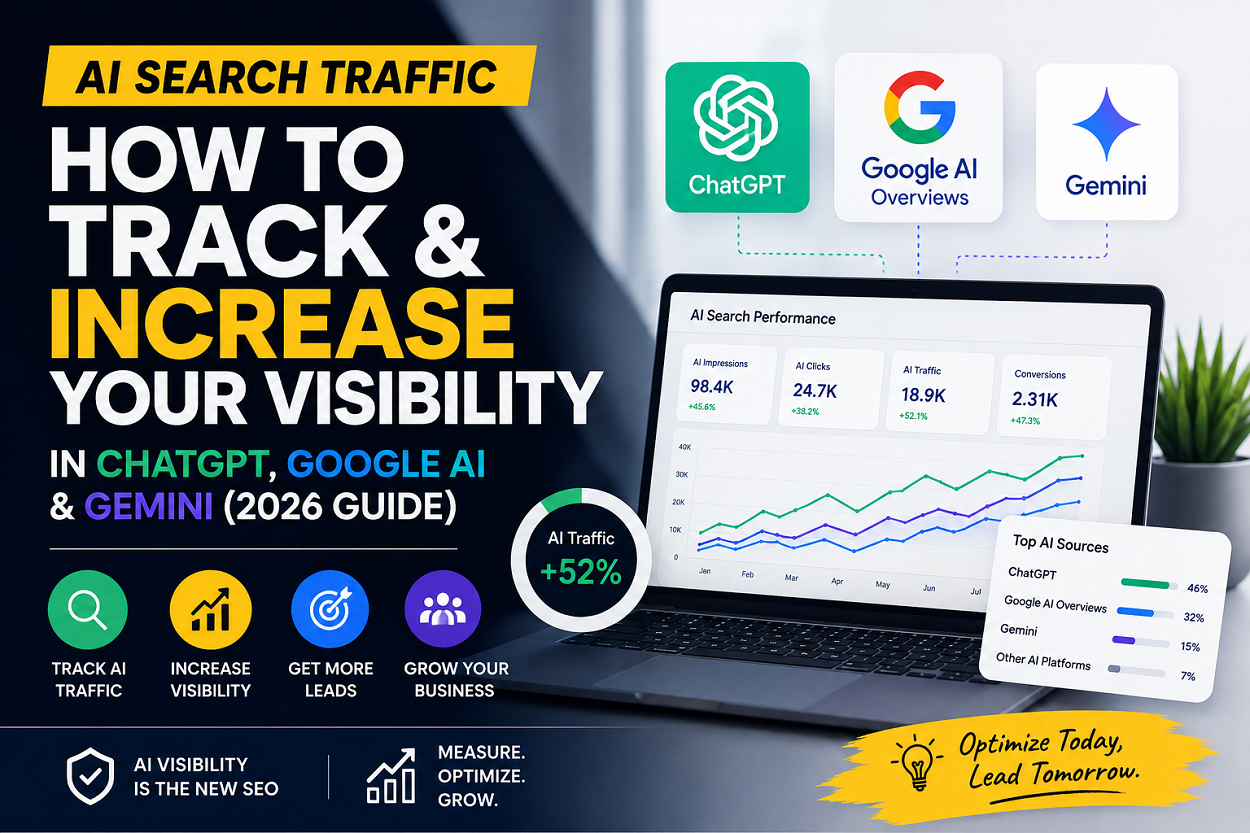

AI search traffic is becoming a measurable acquisition channel for businesses. Websites can gain visibility through Google AI Overviews, AI Mode, ChatGPT, Gemini and other AI-powered discovery experiences.
To increase AI search visibility, businesses should focus on strong traditional SEO foundations, original and useful content, clear answers to specific questions, technical accessibility, brand authority, accurate business information and content that gives AI systems a reason to reference the website.
The bigger change in 2026 is measurement. Businesses should no longer monitor only keyword rankings and Google organic clicks. They should also track AI visibility, citations, referral traffic and conversions generated from AI-driven discovery.
Your Customers Aren’t Searching in One Place Anymore
For years, a typical customer journey looked straightforward.
Someone needed a service.
They searched Google.
They compared a few websites.
They contacted a business.
That journey is becoming much more fragmented.
A potential customer might now ask ChatGPT for recommendations, research the problem through Google AI Mode, compare options through traditional Google results and finally visit a company’s website before making contact.
That creates an important challenge for businesses.
Your website might be performing well in traditional search while remaining almost invisible in AI-generated answers.
Or the opposite may happen: your brand may begin appearing in AI recommendations even when the corresponding page isn’t ranking first organically.
Businesses therefore need to start asking a new question:
How visible is our brand across the entire AI search journey?
What Is AI Search Traffic?
AI search traffic refers to visitors who discover or reach your website through AI-powered search and conversational platforms.
Potential sources include:
- ChatGPT
- Google AI Mode
- Google AI Overviews
- Gemini
- Perplexity
- Microsoft Copilot
- Other AI assistants
However, traffic is only part of the picture.
AI platforms can mention your company without generating a website visit.
That means traditional analytics alone may not reveal your complete AI visibility.
In 2026, businesses should think about AI search performance across three areas:
AI Citations
Is your website being referenced as a source?
Brand Mentions
Are AI systems mentioning or recommending your company?
Referral Traffic
Are people clicking from AI platforms to your website?
All three matter.
Why AI Search Traffic Matters in 2026
AI-powered discovery is no longer a small experiment.
Consumers increasingly use conversational search when they want to:
- Understand complicated topics
- Compare products or services
- Research companies
- Find recommendations
- Make purchasing decisions
- Solve specific problems
These searches can also be much more detailed than traditional keywords.
Someone might traditionally search:
SEO company Portland
But an AI-search query could look like:
Which digital marketing company can help a small Portland business improve local SEO and appear in Google AI results?
That difference matters.
Traditional SEO often targets short keywords.
AI search creates opportunities around complete problems, requirements and conversations.
AI Search Doesn’t Mean SEO Is Dead
This is one of the biggest misconceptions surrounding AI search.
Strong SEO remains essential.
Your website still needs to be:
- Crawlable
- Indexable
- Fast
- Mobile-friendly
- Well structured
- Helpful
- Authoritative
AI optimisation should therefore be viewed as an extension of strong SEO services and SEO strategy, not a replacement for it.
If search engines cannot properly discover and understand your website, trying to optimise it for AI citations won’t solve the underlying problem.
How to Track AI Search Traffic
1. Check Your Website Analytics
Start by examining referral traffic.
Look for visitors arriving from AI platforms and compare:
- Sessions
- Engagement
- Leads
- Conversion rates
- Pages visited
Don’t focus exclusively on traffic volume.
A small number of highly qualified visitors can be significantly more valuable than thousands of informational clicks.
For example, ten AI referrals that generate two sales may be more valuable than 500 blog visitors who immediately leave.
2. Monitor Google Search Console
Search Console remains one of the most important tools for understanding organic search performance.
Monitor:
- Impressions
- Clicks
- Queries
- Landing pages
- Average position
As Google’s AI search measurement capabilities evolve, businesses should also monitor any available reporting related to generative search visibility.
This allows you to identify whether particular pages are gaining exposure within AI-driven search experiences.
3. Test Important Customer Questions
Create a list of questions your ideal customers commonly ask.
For an SEO company, these could include:
- How much does SEO cost?
- How long does SEO take?
- Is SEO worth it for a small business?
- How do I rank on Google Maps?
- What is the best SEO strategy for a local business?
- How do I optimize my website for AI search?
Then examine the sources and companies AI systems surface.
This shouldn’t be treated as perfect ranking data because AI responses can vary.
Instead, use it to understand your competitive landscape.
If the same competitors repeatedly appear while your company does not, investigate what information and authority signals those competitors provide.
4. Track AI Citations Separately From Rankings
Traditional SEO asks:
Where do we rank?
AI search introduces another question:
Where are we cited?
Create a simple AI visibility report containing:
| Metric | What to Measure |
|---|---|
| Organic rankings | Google keyword positions |
| AI citations | Pages referenced in AI answers |
| Brand mentions | AI responses mentioning your business |
| AI referral traffic | Visits originating from AI platforms |
| Conversions | Leads or sales from AI referrals |
| Citation pages | Pages earning the most AI visibility |
This provides a much broader view of search performance.
How to Increase AI Search Visibility
Tracking is only useful if you know how to improve performance.
Here are the areas businesses should prioritize.
1. Stop Creating Generic Content
The internet doesn’t need another article that simply explains:
What is SEO?
Thousands already exist.
Instead, create content that answers specific problems.
For example:
Generic:
What Is Local SEO?
Better:
Why Isn’t My Business Showing Up in Google Maps?
Generic:
What Is Website Optimization?
Better:
Why Does My Website Get Traffic But No Leads?
The second versions reflect genuine customer problems.
They also give search engines and AI systems more specific information to work with.
2. Put the Answer Before the Explanation
Many websites bury the answer beneath several paragraphs of introduction.
Instead, answer the main question immediately.
For example:
How long does SEO take?
SEO typically requires several months before meaningful improvements become visible, although the timeline depends on competition, website authority, technical condition, content quality and the market being targeted.
You can then explain each factor in detail.
This format benefits:
- Users
- Featured snippets
- AI answers
- Voice search
- Google AI experiences
It also makes your content easier to understand.
3. Create Information AI Can’t Find Everywhere Else
This may be one of the most important changes in content marketing.
If 500 websites say exactly the same thing, why should an AI system reference yours?
Give your content information competitors don’t have.
That could include:
- Original research
- Client results
- Internal data
- Industry observations
- Experiments
- Before-and-after examples
- Expert commentary
For example:
Instead of writing:
Website speed improves conversions.
Publish something like:
After reducing a client’s mobile load time from X seconds to Y seconds, we measured a Z% increase in qualified inquiries over the following period.
Real data creates information worth referencing.
4. Build Topic Clusters Instead of Isolated Blogs
One article rarely establishes expertise.
Create clusters around your services.
For example:
AI Search Cluster
Pillar Content
How to Optimize Your Website for ChatGPT, Google AI & Gemini
Supporting Content
- How Google AI Overviews Are Changing SEO
- SEO vs AEO vs GEO
- How to Build Topical Authority
- Why AI-Generated Content Fails to Rank
- How to Track AI Search Traffic
- How to Get Your Business Mentioned by AI
Connect these articles through relevant internal links.
This gives search engines a clearer understanding of your expertise.
5. Strengthen Your Brand Across the Web
AI visibility isn’t purely a website-content problem.
Your business should have consistent information across trusted online sources.
Pay attention to:
- Business directories
- Google Business Profile
- Industry websites
- Review platforms
- Social profiles
- Professional profiles
- Relevant publications
Keep important information consistent, including:
- Business name
- Services
- Location
- Website
- Contact information
- Company description
Clear entity information makes it easier for search and AI systems to understand who your company is and what it does.
6. Invest in Technical SEO
AI optimization cannot compensate for a poorly built website.
Important technical foundations include:
- Crawlable pages
- Correct indexing
- XML sitemaps
- Mobile optimization
- Fast loading
- HTTPS
- Logical site architecture
- Canonical implementation
- Clean internal linking
Businesses experiencing technical problems should address those issues before attempting advanced AI optimization.
A strong <a href=”/website-development-services”>website development strategy</a> should consider SEO from the beginning rather than treating optimization as something added after launch.
7. Use Structured Data Correctly
Structured data can help search engines understand important information about your website.
Depending on the page, relevant structured data may include:
- Organization
- LocalBusiness
- Article
- Product
- Breadcrumb
- Service-related information where applicable
However, schema markup isn’t a shortcut to AI citations.
It should accurately describe information that genuinely exists on the page.
8. Create Content for Complex Questions
AI search makes detailed queries much easier.
Businesses should therefore expand beyond traditional keyword research.
Instead of targeting only:
local SEO services
consider questions such as:
How can a local business improve Google Maps rankings without increasing ad spend?
Or:
Why does my competitor rank above me even though my business has more reviews?
These questions reveal deeper intent.
And deeper intent often creates better opportunities for both traffic and conversions.
9. Make Important Claims Easy to Verify
AI systems need trustworthy information.
When discussing statistics, research or industry developments:
- Reference original sources
- Identify dates
- Avoid unsupported claims
- Keep information current
- Correct outdated content
A vague claim such as:
AI search has completely replaced Google.
is neither accurate nor useful.
A sourced, specific statement is much stronger.
Trust is becoming a competitive advantage.
10. Update Your Best Content Instead of Constantly Publishing More
More content doesn’t automatically mean more visibility.
Sometimes updating ten strong articles creates better results than publishing 50 new ones.
Review existing content for:
- Outdated information
- Weak introductions
- Missing examples
- Broken links
- Old statistics
- Thin sections
- Poor internal linking
Then strengthen the pages already showing potential.
What Should You Measure Beyond Traffic?
This is where businesses need to change their thinking.
Historically, SEO reports emphasized:
- Rankings
- Clicks
- Sessions
Those metrics remain useful.
But AI-era reporting should also consider:
Brand Visibility
How frequently does your company appear during relevant research journeys?
Citation Visibility
Which pages are being referenced?
Qualified Visits
Are visitors actually interested in your services?
Assisted Conversions
Did AI discovery contribute to a customer eventually contacting your company?
Leads and Revenue
Ultimately, marketing should contribute to business results.
A thousand additional visits mean very little if none become customers.
Will AI Search Reduce Organic Traffic?
For some informational searches, it can.
When AI provides a complete answer directly, users may have less reason to click.
This is particularly relevant for simple queries such as definitions and basic explanations.
However, commercial decisions are different.
Someone choosing:
- An SEO agency
- A website developer
- An attorney
- A healthcare provider
- A contractor
usually needs more than a short AI-generated summary.
They still need to evaluate the business.
That makes your website essential.
The goal is therefore not simply getting the click.
The goal is becoming one of the businesses users consider when they’re ready to make a decision.
SEO and AI Search Should Be One Strategy
Businesses shouldn’t create separate strategies that fight each other.
Think of modern search visibility as a connected system.
SEO helps search engines discover, understand and rank your website.
AEO makes your information easier to surface as direct answers.
GEO focuses attention on how brands and content appear within generative AI experiences.
The terminology will continue evolving.
The underlying objective remains straightforward:
Become the most useful, trustworthy and relevant source for the problems your customers are trying to solve.
AI Search Optimization Checklist
Before publishing an important page, ask:
- Does the page answer a specific customer problem?
- Is there a direct answer near the beginning?
- Does it contain information competitors don’t have?
- Are important claims supported?
- Is the author or business expertise clear?
- Does it link to relevant supporting content?
- Is the page technically accessible?
- Is it fast and mobile-friendly?
- Is business information accurate?
- Does the page have a clear next step for visitors?
- Can performance be measured?
If several answers are “no,” optimize the page before producing another article.
Frequently Asked Questions
Can I track traffic from ChatGPT?
Referral traffic from AI platforms can appear in website analytics when users follow links to your site. However, AI brand visibility can occur without a click, so referral traffic alone doesn’t represent your complete AI presence.
Can Google Search Console show AI Overview traffic?
Google continues evolving how AI-related search visibility is reported. Website owners should monitor Search Console for available AI-search reporting while continuing to evaluate overall impressions, clicks, queries and landing-page performance.
Does appearing in ChatGPT improve Google rankings?
There is no simple rule that a ChatGPT mention directly improves Google rankings. Treat traditional organic rankings and AI visibility as related but distinct discovery opportunities.
Does schema guarantee AI citations?
No. Structured data can help machines understand page information, but it does not guarantee that a website will appear in an AI-generated response.
Should businesses still invest in SEO?
Yes. Strong SEO fundamentals remain essential for Google Search and provide many of the technical and content foundations required for broader AI visibility.
What content is most likely to perform in AI search?
Useful content that directly answers specific questions, demonstrates genuine expertise, provides original information and is technically accessible has the strongest foundation for visibility.
Final Thoughts
The biggest change in search isn’t simply that AI can answer questions.
It’s that businesses now have to compete for visibility before a customer reaches a traditional search-results page.
That changes what successful digital marketing looks like.
Ranking still matters.
Traffic still matters.
But citations, brand mentions, authority and qualified visits matter too.
Businesses that start measuring these signals now will have a much clearer understanding of how customers discover them as AI-powered search continues to grow.
At Prisham Web Solutions, we help businesses strengthen visibility across traditional and AI-powered search through SEO services, technical optimization, content strategy, local SEO and conversion-focused website development.
Our focus is not chasing the latest acronym. It’s building digital authority that helps customers discover and trust your business wherever they search.

No Comments